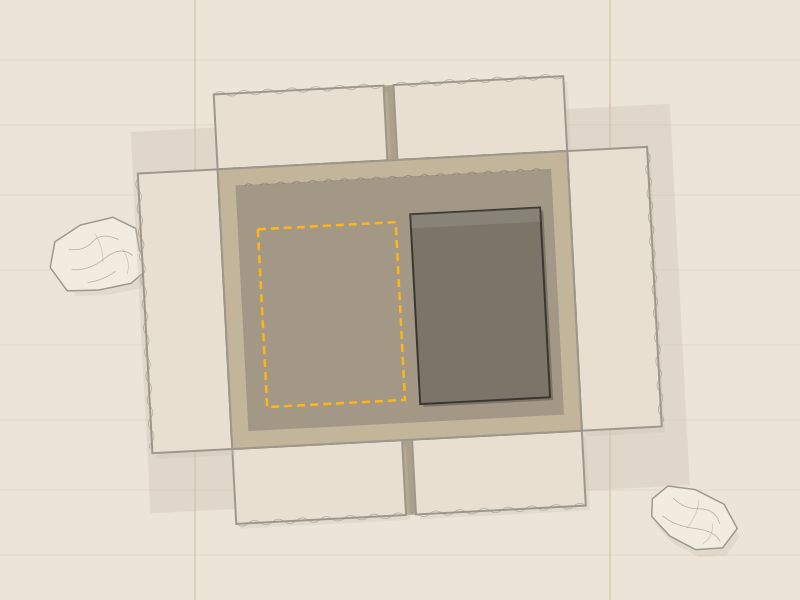
- Six recurring packaging mistakes account for the bulk of shipping damage in parcel logistics.
- Every damage pattern maps to a concrete cause and to a fix with a follow-up rule.
- Three failure modes are solved by a material change, three by adjusting the box or the packing process.
Shipping damage often looks random. It isn't.
Most damage cases trace back to a small set of recurring packaging mistakes. Once you know the six most common ones, you can read the cause off a damage photo in under a minute.
Every claim becomes an instruction for the packing station, instead of an open position on the ticket pile.
Why isn't "more cushioning" a strategy?
More cushioning won't solve a problem that sits in the box itself.
Cushioning only works where it sits between product and wall. In an oversized box, it never reliably fills the void space. The contents slip through the cushioning and still hit the wall. More cushioning in this case only increases material use, not protection.
The order of decisions is clear.
- Box size first, max 2 cm of void all around.
- Cushioning type next, hardness matched to product density.
- Cushioning quantity last, fill voids completely, don't stuff generously.
Reverse the order and start with cushioning, and you're treating symptoms.
Which 6 packaging mistakes appear most often in damage statistics?
The table maps each damage pattern to its cause and names the fix plus the new rule at the packing station. Three of the fixes are a material change, three address the box or the packing process. Materials matching the three material fixes follow directly below the table.
| Damage Pattern | Cause | Fix | New Rule at Packing Station |
|---|---|---|---|
| Contents shifted, scratches in a line | Box too large, cushioning doesn't fill the void | Switch to the next smaller standard box size, fill the remaining void space completely. | Max 2 cm of void between product and wall, otherwise smaller box. |
| Pressure marks or indentations on the product | Cushioning too hard or too soft for the product weight | Choose cushioning type by product density, use Bubble Wrap in the matching thickness. | Cushioning hardness must match product density, one standard type rarely covers all SKUs. |
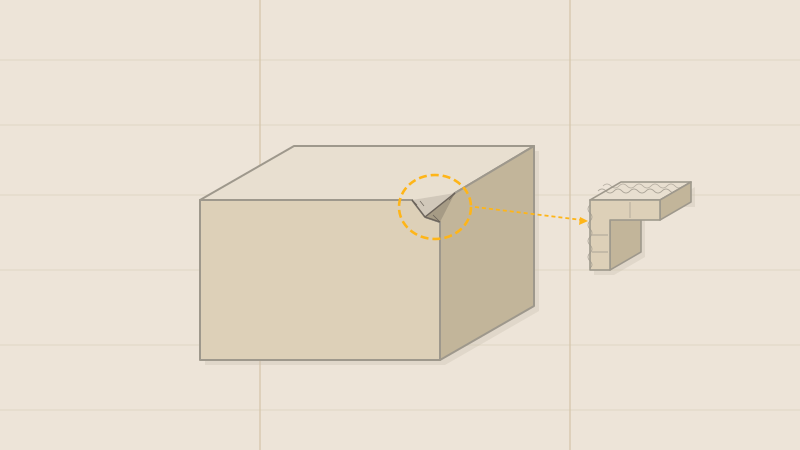
| Crushed corners, edge breaks on the product | Hard product edges unprotected against the box wall | Fold Corrugated Cardboard Roll into a multi-layer corner protector and apply along long edges and corners. | For products with hard edges, a folded corner protector is mandatory, regardless of other cushioning. |
| Multiple parts scratched or broken against each other | Loose arrangement, no separation between parts | Insert Padding Paper as a divider between parts, or wrap each part individually. | Touching parts are always packed separately, no shared compartments without a divider. |
| Box bulged, contents leaning sideways | Center of gravity wrongly distributed, heavy item on top or off-center | Place heavy items at the bottom, light items on top, leave a buffer zone at the top. | Heavy at the bottom, light at the top, 3 to 5 cm top buffer zone as standard. |
| Box collapsed, contents crushed | Outer corrugated board too weak for weight and format | Choose flute type and burst strength by weight and format, use double-wall corrugated for large formats. | Set burst strength class per weight class and document it in the box matrix. |
How do you read a damage photo to find the cause?
Every damage pattern has a signature. Read it and you jump straight to the cause, no lengthy diagnosis.
- Scratches in a line across the product point to shifted contents in an oversized box.
- Point-shaped indentations without a line point to the wrong cushioning hardness for the weight.
- A crushed box corner with damage on the product edge points to a missing corner protector.
- Two parts with mirror-image damage point to missing separation between them.
- Box bulged on top with damage on the bottom contents points to a poorly distributed center of gravity.
- Box pressed flat with crushed contents points to corrugated board that's too weak.
The photo in the claim ticket is usually enough to make the call. A second photo of the opened box with the cushioning layer visible makes the signature unambiguous.
Which fixes work immediately, which need process change?
Not every fix is equally fast to implement. The table below sets the priority for the coming week and the coming quarter.
| Fix | Effort | Timeframe |
|---|---|---|
| Fold corner protectors from corrugated cardboard | low, material on hand at the packing station | immediate |
| Add dividers from padding paper | low, roll at the packing station | immediate |
| Establish center-of-gravity rule | medium, update packing instruction | within one week |
| Switch cushioning type | medium, evaluate and source | one to two weeks |
| Adjust box sizes | high, the box matrix needs rework | two to four weeks |
| Adjust corrugated board strength | high, supplier conversation and minimum order quantities | four to eight weeks |
How do you document damage so it triggers improvements?
A damage case without documentation is a damage case that comes back.
The Damage Analysis Sheet captures the five points that decide whether the failure repeats: damage pattern, suspected cause, intervention, follow-up rule and responsible person. Plus date and order number for traceability.
The follow-up rule column is the critical one. It turns the single damage case into an instruction posted at the packing station. The claim becomes a correction, instead of an administrative task on the ticket pile.
Document 15 cases a month and by the end of the quarter you'll see clearly which two or three damage patterns dominate your assortment. That's where the biggest leverage on your return rate sits.
Damage Analysis Sheet
Document every claim in a structured way and turn it into a concrete follow-up rule at the packing station.
Download template