
- Five metrics are enough to steer packaging material decisions, more just blurs the view.
- Each metric needs a definition, a data source, a frequency, an owner, and a threshold.
- A damaged return costs 19.51 euros per parcel on average, which makes the damage rate the most expensive gap.
As an ops lead you decide at product-group level which box becomes the standard and which custom size stays.
One example shows how fast that tips over. Glassware ships in the standard box because the custom size looks more expensive in purchasing. The damage rate climbs, the return costs eat up the saving, and nobody connects the two. Purchasing sees the cheap box, shipping sees the damage, and the numbers sit in separate systems. A fixed metric set closes exactly that gap.
How you lay out the packing station is a different question. Here the point is how you measure whether your material decisions hold up.
Five metrics are enough for that. Each with a clear definition, a fixed data source, and a threshold that forces action.
Which 5 metrics really carry material decisions?
Material decisions act on three levels, on damage, on cost, and on time. These five metrics cover all three without drowning you in detail reports.
- Damage rate per shipment type: share of shipments with transport damage, split by shipment type.
- Return cost share: cost of avoidable returns relative to the revenue of the shipment group.
- Material cost share per shipment: packaging cost relative to shipment value.
- Packing time per shipment type: time per packed shipment, split by standard and custom size.
- Recurring complaint pattern: the same type of damage coming back month after month.
According to the EHI study 2023, avoiding returns is a top priority for 74 percent of retailers. These five numbers hand you the lever for that. The point is not to measure more. The point is to measure the five numbers that can trigger a decision between standard and custom size.
Which shipping KPIs only fill reports without moving anything?
Many dashboards measure what is easy to measure, not what decides. You can skip these values when they lead to no action:
- Overall damage rate with no split by shipment type, because it averages itself away.
- Total shipping cost with no link to shipment value, because it only grows with volume.
- Number of packed shipments, because it says nothing about quality or effort.
- Customer satisfaction as a single figure, when it cannot be traced back to damage causes.
One example makes the difference clear. An overall damage rate of 1.2 percent looks calm. Underneath it, a single shipment type can sit at 4 percent, averaged out by many clean types. You only see the problem once the damage has already turned expensive. The rule is therefore simple. A metric stays only when a clear threshold triggers an action.
How do you define a damage rate that stays comparable across shipment types?
The damage rate is the most expensive gap. The Returns Management Research Group in Bamberg puts a damaged return at 19.51 euros per parcel. Every fifth shipment comes back with damaged original packaging.

To keep the number steerable, you need a clean definition:
- Count shipments with documented transport damage, not every complaint.
- Divide them by the shipment volume per shipment type, not by the total volume.
- Keep the shipment type constant, so the same product group and the same dimensions.
- Pull it from one system, the complaint or returns tool, not from gut feeling.
Do the quick math on what a bad rate costs. At 4,000 shipments a month and a damage rate of 2 percent in one shipment type, that is 80 damaged shipments. Times 19.51 euros, that comes to roughly 1,561 euros a month, in this one type alone. That exact number stays invisible as long as you only look at the overall average. This is how a weak box becomes visible, instead of disappearing into the average of a good product range.
At what frequency do you measure which metric?
Not every number belongs in a monthly rhythm. Damage and complaints need a short-term view, cost and time fit a quarterly one. The reason is simple. Damage needs a fast reaction, while cost shares swing too much in the short term to act on. This set shows definition, data source, frequency, and the threshold where you step in.
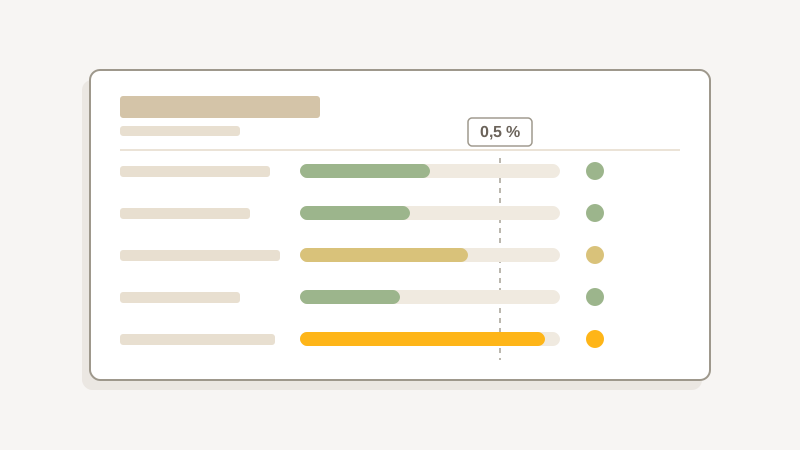
| Metric | Data source | Frequency | Intervention threshold |
|---|---|---|---|
| Damage rate per shipment type | damage per shipment type from the complaint system | monthly | above 0.5 percent in one shipment type |
| Return cost share | return cost to revenue, from accounting and the returns tool | monthly | above internal target per product group |
| Material cost share per shipment | packaging cost to shipment value, from purchasing and shipping data | quarterly | above defined margin on standard shipments |
| Packing time per shipment type | sample at the packing station or from the shipping system | quarterly | custom size takes more than twice as long as standard |
| Recurring complaint pattern | same type of damage over three months, from the complaint system | monthly | same root cause three times in a row |
Who on the team owns which metric?
A metric without a name decays. Assign ownership clearly, so every number has someone who acts on red:
- Damage rate: quality or returns, because the damage shows up there first.
- Return cost share: controlling together with you as the ops lead.
- Material cost share: purchasing, because that is where box and cushioning are negotiated.
- Packing time: the shipping shift lead, closer to the real workflow.
- Recurring pattern: you, because this is where the standard versus custom size decision is made.
Here is what a clean escalation looks like. The damage rate for glassware sits above the threshold for three months. The quality owner reports it in the monthly review, not as an excuse, but as a fact. The decision on firmer cushioning or a smaller custom size then sits with you, with a review date in the following month. On red, what counts is not the explanation, but the action and the review date.
KPI Cockpit for Material Decisions
One page with five metrics, status, and action for the monthly status check.
Download template