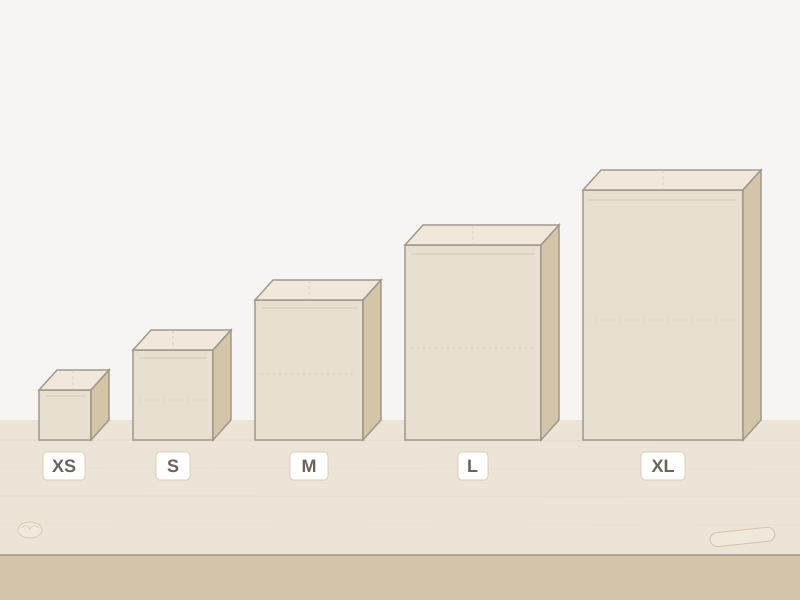
- 4–6 standard carton sizes cover 90% of shipments when chosen correctly.
- Void space costs you three ways: fill material, dimensional weight surcharges, and packing time.
- A carton matrix turns size selection at the packing station into a routine, not a decision.
Most shippers work with too many carton sizes and still end up with void space in every other parcel. A carton matrix with 4–6 standard sizes cuts fill material consumption, dimensional weight surcharges, and packing time. This article walks you through building and validating the matrix for your product range.
Many warehouses stock 12 or more carton sizes. Yet half of all shipments still contain too much air. The problem isn't the number of sizes. It's that nobody checked which sizes actually match the product range.
How many carton sizes does a typical shipper need?
It depends on your product range, but the rule of thumb is: as few as possible, as many as necessary. In most cases, 4–6 sizes cover around 90% of all shipments.
- Fewer than 4 sizes: You force compromises. Small items end up in large cartons, void space and fill requirements increase.
- More than 8 sizes: The packing station decision slows down. Workers pick the wrong carton more often, especially under peak season pressure.
- 4–6 sizes: The range where coverage and ease of use balance out. Each size has a clear assignment, and the decision at the packing station takes seconds.
What matters is not how many sizes you have, but whether each size serves a real purpose in your product range.
What does void space actually cost per shipment?
Void space hits you in three places at once. Most shippers only see the fill material cost and underestimate the other two.
- Fill material: The more air in the carton, the more paper, cushioning, or air pillows you need. At 500 shipments per day and $0.15 of fill material per parcel, that's over $1,500 per month.
- Dimensional weight: Carriers charge the higher value of actual weight and dimensional weight. A carton with 40% void space can land in a higher billable weight bracket without the contents changing at all.
- Packing time: When packers have to search for the right carton or add extra cushioning, each shipment takes 15–30 seconds longer. Over a full day, that adds up to hours.
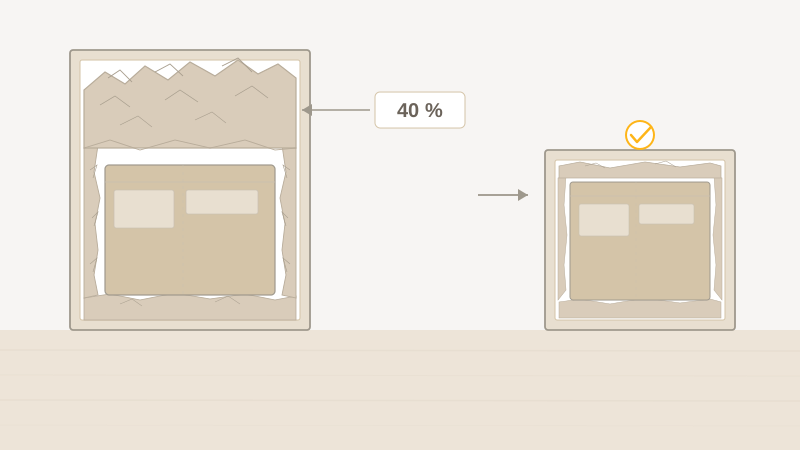
Once you understand that void space costs you in all three areas, the conclusion is clear: carton selection is not a side issue, it's a lever for your per-unit cost.
How do you build a carton matrix for your product range?
You need three steps: measure your range, form clusters, define sizes.
- Measure your range: Measure your 10–20 most shipped products (or product combinations) in L × W × H. Include protective packaging, not just the bare product.
- Form clusters: Group the dimensions by volume. Typically, 4–6 natural clusters emerge where products are similar in size.
- Standard size per cluster: For each cluster, choose a carton that fits the largest product in the cluster while leaving no more than 20% void space. That defines your matrix.
The example matrix below shows what a result might look like. The inner dimensions are reference values. Adjust them in the template to match your own product range.
| Size | Inner dims (L × W × H) | Typical product | Void class | Fill required |
|---|---|---|---|---|
| XS | 200 × 150 × 100 mm | Small parts, accessories, spare parts | Low (under 10%) | None or tissue paper |
| S | 300 × 220 × 150 mm | Books, single garments, flat electronics | Low to medium (10–20%) | Packing paper |
| M | 400 × 300 × 200 mm | Shoes, multi-item orders, mid-size devices | Medium (15–25%) | Packing paper or air pillows |
| L | 500 × 400 × 300 mm | Bulk orders, bulky single items | Medium to high (20–35%) | Air pillows or cushioning pads |
| XL | 600 × 400 × 400 mm | Large appliances, multi-packs, seasonal items | High (over 25%) | Cushioning pads or molded inserts |
Sizes XS through XL are standard corrugated carton formats available from most packaging suppliers as stock items. Working with these ranges means no long lead times and no minimum order quantities for custom sizes.
When does a custom size make sense, and when doesn't it?
A custom size pays off when a product ships in high volume and no standard carton keeps void space below 15%. In all other cases, the downsides outweigh the benefits.
- Custom size makes sense: A product accounts for over 20% of your shipping volume, the closest standard carton has over 30% void space, and the minimum order quantity fits within your quarterly demand.
- Custom size doesn't make sense: The product ships only occasionally, the void space gap to the standard carton is under 15%, or you'd have to warehouse a full year's supply.
The carton matrix helps with this decision too. If a product doesn't fit any of your 4–6 standard sizes well but still has high volume, that's a signal for a custom size. Everything else goes into the next larger standard size with fill added.
Which standard sizes cover most shipment profiles?
There's no universal answer, but there's a pattern. Most e-commerce shippers do well with increments of roughly 100 mm, starting at around 200 mm inner length up to around 600 mm.
- Start with your most shipped product and pick the smallest carton that fits.
- Work your way up. Each new size must cover a product group that doesn't fit the previous size.
- Check at the end: is there a size that covers less than 5% of your shipments? Remove it and redistribute those products to adjacent sizes.
How do you validate the matrix after building it?
A matrix you plan once but never test stays theory. Start with 5 sizes (XS through XL) and track the actual fill requirement per size for four weeks.
- Record how often each size is used and how much void space actually remains.
- Any size covering less than 5% of shipments is a candidate for removal. Redistribute its products to neighboring sizes.
- Any size that regularly shows over 30% void space needs a smaller in-between format or an adjustment to its inner dimensions.
After validation, post the final matrix at the packing station. The assignment "product → carton size" must be recognizable for every team member in seconds. No questions, no guessing.
Carton Size Matrix – Decision Guide
Blank matrix template to fill in with your product range: standard sizes, product assignment, void class, and fill requirement at a glance.
Download template