- The most common shipping cost leaks come from dimensional weight, oversize surcharges, and outdated rate agreements.
- A quick scan with 7 yes/no questions shows you where you overpay in 10 minutes.
- The three fastest levers: review box sizes, understand billable weight, match your shipping profile to your contract.
Every shipper knows what a parcel costs. What most don't know: where those costs quietly increase. Not through price hikes, but through details that slip through the cracks in day-to-day operations.
A box that's two centimetres too long. A billable weight that doesn't match the actual weight. A rate agreement that fit the shipping profile three years ago but no longer does.
This quick scan covers the 7 most common areas where shipping costs rise unnoticed. Each point is a yes/no question. All you need is your latest carrier invoice and 10 minutes.
Which shipping cost items do most shippers overlook?
The obvious items appear in every quote: parcel price, pickup fee, fuel surcharge. The hidden items only show up on the invoice.
- Dimensional weight markup: Carriers bill either the actual weight or the dimensional weight, whichever is higher. Shippers who send light but bulky packages often pay double the actual weight.
- Oversize surcharges: Every carrier defines its own limits for girth and longest side. Just 1 cm over the threshold triggers a surcharge that can range from 3 to 15 euros per parcel.
- Additional fees for special cases: Residential delivery surcharge, island surcharge, cash on delivery, identity verification. These items often only surface in the monthly invoice because they seem small per shipment.
- Rounding differences: Some carriers round weight and dimensions up to full units. At high volumes, this adds up.
How does dimensional weight vs. actual weight affect your invoice?
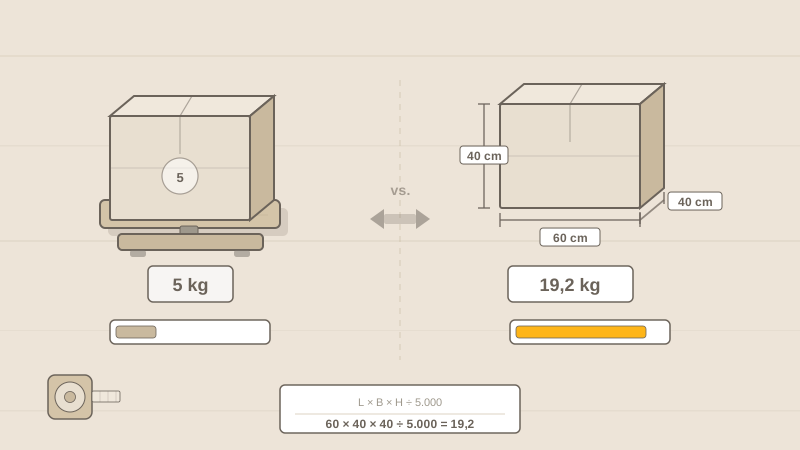
Dimensional weight is calculated with a simple formula: length × width × height in cm, divided by a carrier-specific divisor. For DHL Parcel business contracts, this divisor is 5,000. DPD and GLS also use 5,000 for standard parcels.
A box measuring 60 × 40 × 40 cm has a dimensional weight of 19.2 kg. If the contents only weigh 5 kg, the carrier still bills 19.2 kg.
- The billable weight is always the higher value of actual weight and dimensional weight.
- Shippers who regularly send boxes with a lot of void space are essentially paying for air.
- The fix starts with box selection: less void space means lower dimensional weight.
When do package dimensions trigger oversize surcharges?
Every carrier has its own limits. The exact values change regularly, so it's worth checking your carrier's current rate sheet. The table below shows typical thresholds for 2025 as a reference.
| Carrier | Max. Girth | Max. Longest Side | Oversize Surcharge (approx.) |
|---|---|---|---|
| DHL Parcel | 300 cm | 120 cm | from €3.90 |
| DPD | 300 cm | 175 cm | from €5.00 |
| GLS | 300 cm | 200 cm | from €7.00 |
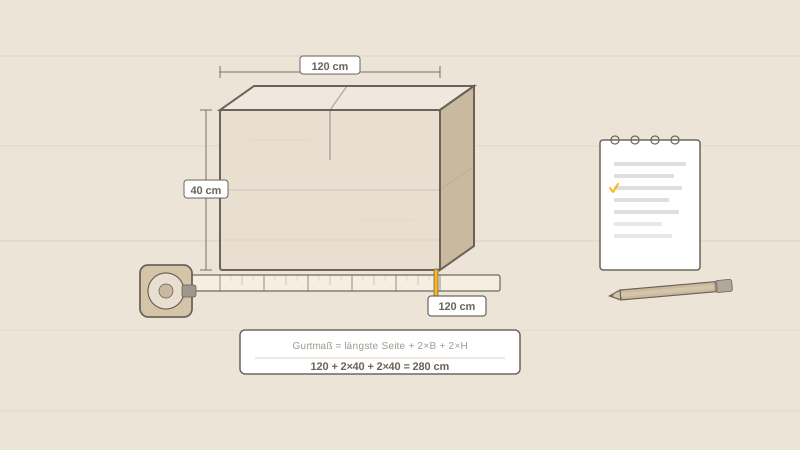
Girth is calculated as follows: longest side + 2 × width + 2 × height. Checking your three most common box sizes against this table often reveals one or two sizes that sit just above a threshold.
How do you know if your rate agreement still fits your shipping profile?
Most shippers negotiate their rate agreement once and then don't review it for years. In the meantime, the shipping profile changes: different box sizes, different weight distribution, different destination regions.
- Check weight bracket distribution: If 70% of your shipments weigh between 5 and 10 kg, but your rate agreement is cheapest in the 0–5 kg bracket, you're paying in the wrong tier.
- Check regional surcharges: Residential delivery surcharges can account for 5–10% of total volume for B2C shippers.
- Check shipment volumes: Many contracts have volume tiers. Shippers who just miss the next tier pay more per parcel than necessary.
Which 3 cost drivers can you fix the fastest?
Not every shipping cost problem requires a new carrier negotiation. Three levers can be reviewed immediately and often adjusted within a week.
- Reduce box sizes: Less void space lowers dimensional weight. In many cases, removing one or two box sizes from the range and replacing them with better-fitting options is enough.
- Eliminate oversize borderline cases: Replace boxes that sit just above a girth or longest-side limit with the next smaller size.
- Review invoices monthly: Not quarterly, but every month. Surcharges that accumulate over weeks go unnoticed otherwise.
How do you use the shipping cost quick scan?
The quick scan consists of 7 yes/no questions. You need your latest carrier invoice and the dimensions of your three most common box sizes.
- Work through the 7 questions in order.
- Every "no" marks a spot where you're likely overpaying.
- Start with the point that comes up most often, not the one that sounds most expensive.
The quick scan doesn't replace a rate negotiation. But it shows you whether you need to negotiate at all, or whether the problem lies somewhere else.
Shipping Cost Quick Scan
7 yes/no questions covering the most common cost traps in shipping, ready to work through with your latest invoice.
Download template