
- The PPWR has applied since 12 August 2026. Immediate obligations: EU declaration of conformity, technical documentation, and substance restrictions.
- Harmonised labelling follows in 2028, recycled content and the empty space limit only in 2030. Do not confuse these timelines.
- The declaration is issued by the manufacturer of the packaging. If you buy standard boxes, that is usually not you.
Update of 12 August 2026: The PPWR applies from today. In parallel, the German Packaging Law Implementation Act (VerpackDG) replaces the previous Packaging Act, published in the Federal Law Gazette on 17 July 2026. LUCID registration and system participation remain in place. You can request declarations of conformity for our articles at info@verpacking.com, subject line PPWR.
Since 12 August 2026, Regulation (EU) 2025/40, the Packaging and Packaging Waste Regulation (PPWR), has applied directly in all EU Member States. No national transposition required, no remaining transition periods for the immediate obligations.
The regulation contains requirements across multiple timelines. Operators who treat every requirement as an August 2026 issue will either overreact or miss real gaps. Separating what applies now from what applies in 2028 and 2030 is the first practical step.
This article does not constitute legal advice. It provides a structured status check. Reference date: August 2026.
What applies now, and what only from 2028 and 2030?
The PPWR is a phased framework, not a single deadline. Operators treating all requirements as immediate face unnecessary cost and complexity.
Immediate obligations since 12 August 2026:
- EU declaration of conformity for packaging placed on the EU market. It is issued per packaging type, not per shipment or batch
- Technical documentation supporting the declaration. Retention is five years for single-use packaging and ten years for reusable packaging
- Substance restrictions: a combined limit of 100 mg/kg for lead, cadmium, mercury, and hexavalent chromium, plus PFAS limits for food contact packaging
- Conformity assessment procedure must be traceable and documented
| Requirement | Applies from | What this means |
|---|---|---|
| EU declaration of conformity and technical documentation | 12 Aug 2026 | Request records from your supplier and archive them |
| Substance restrictions, heavy metals and PFAS | 12 Aug 2026 | Covered by the manufacturer, no testing on your side |
| Compostability of specified packaging | 12 Feb 2028 | Applies to stickers and tea bags, not to boxes |
| Harmonised labelling of material composition | 12 Aug 2028 | Applied to the packaging by the manufacturer |
| Recyclability grades and minimum recycled content | 1 Jan 2030 | Plan material changes now, no need to buy today |
| Empty space ratio of 50% | 1 Jan 2030 | Evaluate box sizes now, switching takes lead time |
Who must issue the EU declaration of conformity?
The EU declaration of conformity is a written statement confirming that the packaging meets the requirements of the PPWR. It does not come from an authority, it comes from the supply chain.
The PPWR separates two roles, and this is where most of the confusion starts. In everyday English the two terms sound interchangeable. Under the regulation they are not:
- Manufacturer: produces the packaging, or has it produced under its own name or trademark. Responsible for conformity and issues the declaration.
- Producer: makes packaging or packaged products available on a Member State market for the first time. Handles registration and reporting, but does not issue the declaration of conformity.
For online sellers this means: if you buy standard boxes, you are not the manufacturer. The declaration comes from the box manufacturer and belongs in your records. If you have boxes produced to your own specification, for example with your own logo, design, dimensions, or material requirements, you can become the manufacturer yourself.
One exception is set out in the DIHK guidance note. Where the ordering party is a micro-enterprise as defined by the EU, the supplier is treated as the manufacturer instead, provided the supplier is established in the same Member State.
- Obtain and archive conformity documentation from suppliers
- Clarify your own role explicitly for any custom-made packaging
- Store technical documentation so it can be produced to market surveillance authorities within ten days of a request
What changes for sellers already registered in the LUCID Packaging Register?
LUCID stays, the legal basis changes. On 12 August 2026 the Packaging Law Implementation Act (VerpackDG) replaced the previous German Packaging Act. The Central Agency Packaging Register and the LUCID register remain in place, as do registration, system participation, and data reporting.
What changes is the logic behind them. Who has to meet which obligation, and under what conditions, is now determined by the PPWR roles rather than by the definitions of the old Packaging Act. In addition, a current LUCID registration alone does not fulfil the PPWR conformity obligations. Both documentation chains must be complete and maintained independently.
- Review LUCID registration for completeness, especially after product or packaging changes
- Assess your role against the PPWR definitions, not against the previous national logic
- Build PPWR conformity documentation separately, do not merge it with system participation records
Does the empty space rule apply now, and what counts as void space?
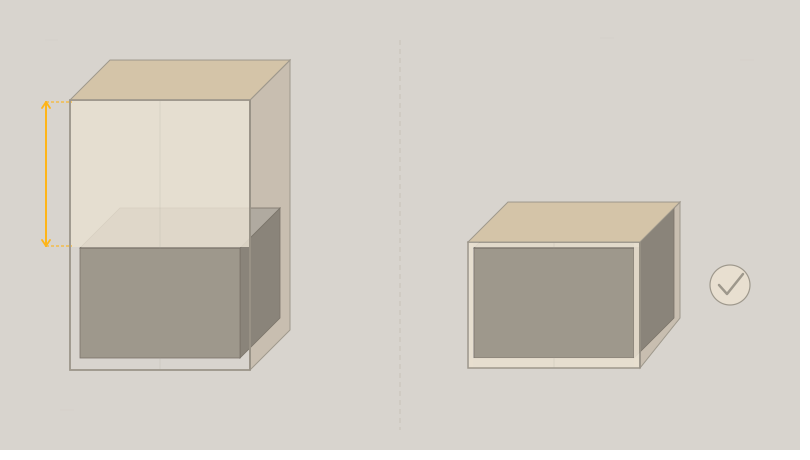
No. The maximum empty space ratio of 50% applies from 1 January 2030 only. There is no obligation on this point in 2026.
However, right sizing your packaging today reduces shipping costs immediately and positions the operation for 2030. Under the PPWR text, void fill such as air cushions, paper padding, or foam chips counts as empty space, not as usable volume. Reducing box size is the more direct lever.
The box size matrix in our shipping know-how section provides a framework for evaluating void space per box format today.
Do small online shops qualify for exemptions?
The PPWR does not distinguish by company size as a general rule. All operators placing packaging on the EU market fall within scope. Some obligations do include scaled requirements:
- Producers placing no more than 10 tonnes of packaging on a Member State market per year benefit from simplified registration and reporting obligations (Art. 44(8)).
- The micro-enterprise rule described above shifts the manufacturer role to the supplier.
- Scaled requirements also apply to re-use targets.
The declaration of conformity obligation itself does not disappear. It shifts, depending on who qualifies as the manufacturer. If you are unsure which role applies to your operation, obtain legal advice. A checklist is not a substitute for that assessment.
What happens when records are incomplete?
The PPWR does not define EU-wide penalties. Enforcement sits with the Member States, in Germany through the VerpackDG.
In practice, records are requested through two channels:
- Market surveillance authorities can request the declaration of conformity and the technical documentation. Records are typically to be produced within ten days.
- Buyers and wholesale partners request the records for their own documentation. This is currently the more frequent case.
Complete records are therefore not an end in themselves. They are the difference between a request you answer in ten minutes and one that occupies you for two weeks.
How do you get the records for your packaging?
We hold the declarations of conformity issued by our manufacturers and provide them on request. There is no open download by design, because supplier records range from a single page to 50 pages. On request you receive exactly what applies to your articles.
- Send your request to info@verpacking.com, subject line PPWR
- Include the article number or article name
The dimensions for each article are listed directly in the product description in our shop.
Where does your operation stand?
The 7-point immediate audit: Rate each item honestly: Yes (completed and documented), No (not yet started), In Progress (started but not complete).
| Checkpoint | Status |
|---|---|
| EU declaration of conformity in place for every packaging type in use | Yes / No / In Progress |
| Technical documentation complete, retention secured for 5 years single-use and 10 years reusable | Yes / No / In Progress |
| Your own PPWR role clarified: manufacturer or not | Yes / No / In Progress |
| LUCID Packaging Register registration current (all packaging categories covered) | Yes / No / In Progress |
| Packaging materials assessed for recyclability (preparation for 2030) | Yes / No / In Progress |
| Box size range evaluated for void space reduction (preparation for 2030) | Yes / No / In Progress |
| Supplier conformity documentation obtained and archived | Yes / No / In Progress |

All seven on Yes: your operation is structurally prepared. Multiple No items in the first three checkpoints: role clarification, the declaration of conformity, and technical documentation are the priority. The PPWR Readiness Checklist below provides a structured format for closing gaps and assigning ownership.
Sources
PPWR Readiness Checklist
One-page status assessment with traffic-light rating for all 7 checkpoints, including gap field, next action, ownership, and deadline.
Download template