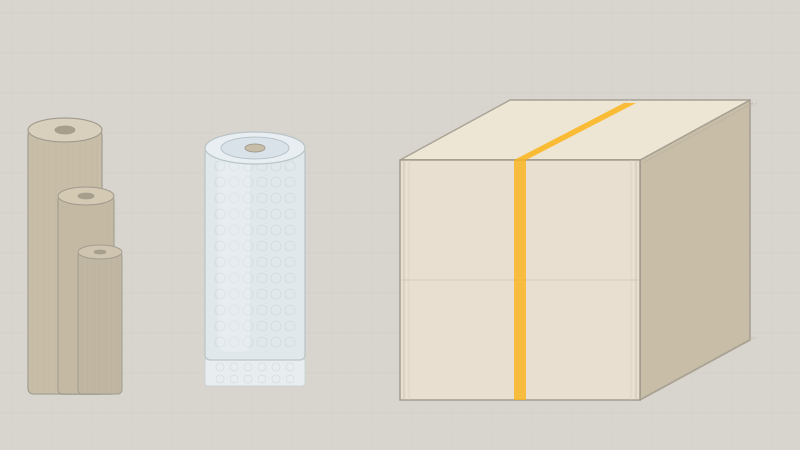
- Eight shipment types each get a fixed material set, replacing ad-hoc decisions at the packing station
- The rule of thumb: surface area and void space call for paper, targeted impact protection calls for bubble wrap
- Free template to print and hang at the packing station, ready to use without training
At the packing station, people improvise. Whoever has a spare moment grabs the material that's closest at hand.
The cost doesn't show up in the material budget. It shows up in the damage rate, when electronics arrive wrapped in kraft paper instead of bubble wrap.
This matrix defines the right material for eight common shipment types and shows where to find it.
For guidance on how much of each material you need, see the Pillar Hub: Packing Materials.
Why does inconsistent void fill cost more than poor void fill?
Poor material is obvious, it tears or fails to cushion. Inconsistent material only shows up later, when damage rates climb and no one knows why.
A real example: a shipment type without a fixed set gets bubble wrap today. Tomorrow it gets kraft paper.
For glass or ceramics, that difference decides between an intact item and a return. The damage rate doesn't spike from one mistake. It creeps up through small deviations repeated over weeks.
There's a second cost: time. Every person at the packing station has to make the material call from scratch. A few seconds per shipment adds up to real minutes per day at volume.
- Every packer makes the material decision independently, based on what's available that day
- Damage claims cluster around the shipment types that have no fixed set
Which shipment types need which material combination?
The matrix is straightforward. Find the shipment type, and the right combination is already there.
| Shipment type | Box / packaging | Cushioning / void fill | Closure / sealing | → Shop |
|---|---|---|---|---|
| Books, catalogues, flat print | Book packaging | None, contents sit flat and stable | Paper tape | Book Packaging |
| Clothing, textiles, soft goods | Poly mailer | None, material is soft by nature | PP tape | Poly Mailers |
| Electronics, sensitive devices | Double-wall box | Bubble wrap around critical points | PVC tape, reinforced | Bubble Wrap |
| Glass, ceramics, fragile goods | Double-wall box | Air cushions, item fully enclosed | PVC tape, reinforced | Not in range |
| Cosmetics, liquids with protective packaging | Single-wall box | Tissue paper plus protective bag | Paper tape | Tissue Paper |
| Tools, heavy or sharp-edged items | Double-wall box with edge protectors | None, edge protectors take over | Duct tape | Not in range |
| Multiple small items in one shipment | Single-wall box with dividers | Cushioning paper for separation and fixation | Paper tape | Cushioning Paper |
| Return shipment set (outbound and return) | Double-wall box, reusable | Minimal, designed for second use | Double-sided tape for second closure | Double-Sided Tape |
When is paper cushioning better than air cushions, and when is it the other way around?
Paper cushioning works well for void space and light fill. Kraft paper or cushioning paper is a good fit for multiple small items in one shipment.
Air cushions and bubble wrap are better for targeted impact protection. Electronics with individual sensitive components are a typical use case.
For glass and ceramics, bubble wrap is the more reliable choice. It wraps around the item completely.
For multiple small items, paper cushioning is often the most practical option. It can be cut quickly and keeps items separated.
Paper is also lighter in terms of billable weight and easier to dispose of. Air cushions require a filling device at the packing station, which takes up extra space.
Rule of thumb: surface area and void space call for paper, targeted impact calls for air.
Which material combinations are clear no-gos?
These are the combinations that come up most often in practice. The matrix above helps you avoid them.
- Heavy tools in a single-wall box without edge protection, the box collapses under load at the corner
- Glass or ceramics with only a thin kraft paper layer and no additional cushioning, not enough for impact
- Cosmetics with liquids in the same box as textiles without protective packaging, a leak ruins both
- Return sets sealed with single-use tape that fails on the second closure
- Single-wall boxes for shipments over 10 kilograms, the box loses its shape under load
For help choosing the right outer box dimensions, see the box size matrix article.
How do you make sure the right material set is always within reach?
The best matrix does nothing if it only lives in an internal wiki. At the packing station, what matters is what's visible and within arm's reach.
- Store each material set directly at the packing station, don't make packers fetch from a central store
- Laminate the template and hang it up so new team members can pack correctly without asking
- Label each material's storage spot with a colour or symbol. The assignment stays clear even without the sheet
During peak season, the dominant shipment types shift fast. Storage labels should be reviewed regularly, not just set up once.
When your product range changes, for example new sizes or new categories, the material assignments need revisiting too. A quick quarterly check is enough to catch gaps before they cause damage.
Without that check, templates go stale. They stop matching the actual shipment mix. Short feedback loops from the team help catch deviations early.
Put these three things in place and no one at the packing station needs to ask which material to use. That holds regardless of who's on shift.
The packing material setup template maps exactly this, shipment type to material set to quantity.
Packing Material Setup Template
Eight shipment types with fixed material sets, quantity guides, and exception notes, ready to print.
Download template